
- What Is Promotion and Relegation in English Football?
- Understanding the English Football Pyramid
- How Promotion Works in English Football
- Automatic Promotion Explained
- How Promotion Playoffs Work
- How Relegation Works
- The Premier League Promotion and Relegation System
- Promotion and Relegation in the EFL Leagues
- Why Promotion and Relegation Makes English Football Unique
- The Impact of Promotion and Relegation on Football Clubs
- Frequently Asked Questions About English Football Promotion and Relegation
English football is built on a simple but powerful idea: no club’s place in the game is guaranteed. Whether you support a Premier League giant or a part-time club in the seventh tier, your team’s fate each season is tied to results on the pitch. This is the essence of promotion and relegation — a system that connects every level of English football into a single, continuous pyramid.
For fans new to the English game, this structure can seem unusual, especially if you’re used to closed leagues like those in North American sports. This guide explains exactly how promotion and relegation work, how the English football pyramid is organized and why the system is considered one of the defining features of football in England.
What Is Promotion and Relegation in English Football?
Promotion and relegation is a system where clubs move up or down between different divisions based on their performance over a season. Finish near the top of your league and you can be promoted to a higher division. Finish near the bottom and you face relegation to a lower one.
This applies not just to the Premier League, but to dozens of divisions beneath it, forming what is commonly called the English football pyramid. In theory, a small amateur club could climb, division by division, all the way to the Premier League — and a Premier League club could fall the other way if results go badly enough over consecutive seasons.
The system rewards success and punishes failure directly, creating stakes at both ends of every table, not just at the top.
Understanding the English Football Pyramid
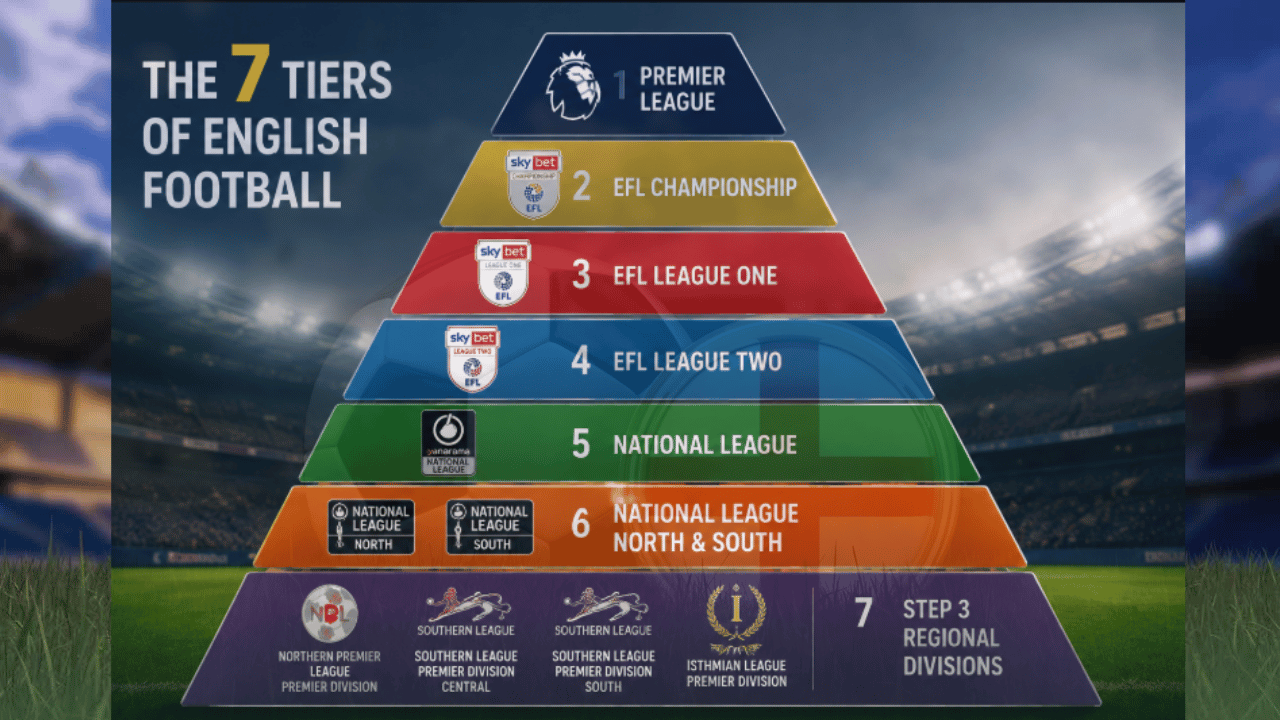
The English football pyramid refers to the interconnected network of leagues that make up the professional and semi-professional game in England. Each division is linked to the one above and below it through promotion and relegation, meaning results in even the lowest tiers can technically affect who eventually reaches the top.
The main tiers, from the top down, include:
- Tier 1 – Premier League (20 clubs)
- Tier 2 – EFL Championship (24 clubs)
- Tier 3 – EFL League One (24 clubs)
- Tier 4 – EFL League Two (24 clubs)
- Tier 5 – National League (non-league, but linked to the EFL)
- Tiers 6 and below – Regional non-league divisions, county leagues and grassroots football
The Premier League and the three EFL divisions (Championship, League One, League Two) make up the professional core of English football. Below that, the National League system connects semi-professional and amateur clubs into the same pyramid, meaning a non-league club can, in principle, work its way up into professional football.
This layered structure is what makes the pyramid concept meaningful, it isn’t just the Premier League and a handful of divisions beneath it, but a continuous chain stretching down to local football.
How Promotion Works in English Football
Promotion is the process by which a club moves up from a lower division to a higher one at the end of a season. In most English divisions, there are two distinct routes to promotion:
- Automatic promotion – awarded to the clubs that finish highest in the table
- Playoff promotion – decided through a knockout competition among clubs just below the automatic spots
Both routes exist within the same division in most leagues, meaning a club doesn’t need to win the league outright to earn promotion — finishing strongly is often enough to create an opportunity.
Automatic Promotion Explained
Automatic promotion means a club secures its place in the higher division purely based on league position, with no additional matches required. The number of automatic promotion spots varies slightly by division, but the general pattern across the EFL is as follows:
- Championship to Premier League: Top 2 clubs are automatically promoted
- League One to Championship: Top 2 clubs are automatically promoted
- League Two to League One: Top 3 clubs are automatically promoted
Automatic promotion is generally seen as the most secure route, since it’s determined over the course of a full season (typically 46 games in the EFL) rather than a small number of knockout matches. Consistency across the season matters more than a short run of form.
How Promotion Playoffs Work
Below the automatic promotion places, several divisions use a playoff system to determine one additional promoted club. This adds late-season drama and gives more clubs a realistic chance of moving up, even if they didn’t finish at the very top of the table.
The typical structure works like this:
- The clubs finishing immediately below the automatic promotion spots (usually 4 teams, from 3rd to 6th place) qualify for the playoffs
- These four clubs are drawn into two semi-final matchups, usually played over two legs (home and away)
- The two winners advance to a single playoff final, traditionally held at a neutral venue
- The winner of the final earns the final promotion spot for that division
The Championship playoff final, which decides the last club promoted to the Premier League, is widely regarded as one of the most valuable single matches in football due to the financial difference between the Premier League and the Championship.
Because playoff outcomes depend on a small number of matches rather than a full season, they introduce an element of unpredictability that automatic promotion does not, a club with a modest league finish can still earn promotion by peaking at the right time.
How Relegation Works
Relegation is the reverse of promotion: it’s the process by which clubs finishing near the bottom of a division are moved down to a lower league for the following season. Unlike promotion, relegation in English football is almost always automatic and based purely on final league position — there are no relegation playoffs in the main professional divisions.
The general pattern is:
- Premier League to Championship: Bottom 3 clubs are relegated
- Championship to League One: Bottom 3 clubs are relegated
- League One to League Two: Bottom 3 clubs are relegated
- League Two to National League: Bottom 2 clubs are typically relegated (this number has varied slightly over different seasons)
Because relegation is determined by final position rather than a knockout round, it tends to be the result of sustained underperformance over many months, rather than a single poor run of form.
The Premier League Promotion and Relegation System
At the top of the pyramid, the Premier League operates a straightforward relegation system rather than a promotion one, since there’s no division above it. Each season:
- The bottom three clubs in the Premier League table are relegated to the Championship
- The top two clubs from the Championship are automatically promoted to the Premier League
- The winner of the Championship playoff final takes the third and final promotion spot
This means three clubs move up from the Championship each year, replacing the three relegated from the Premier League. The financial stakes here are especially high, since Premier League broadcast revenue is significantly greater than in the Championship, making promotion and relegation at this level some of the most closely watched storylines in English football each season.
Promotion and Relegation in the EFL Leagues
The same core structure — automatic promotion, playoffs and automatic relegation, repeats throughout the English Football League (EFL), connecting the Championship, League One and League Two.
- Championship: Top 2 automatic, positions 3–6 enter the playoffs, bottom 3 relegated
- League One: Top 2 automatic, positions 3–6 enter the playoffs, bottom 3 (sometimes 4, depending on the season’s rules) relegated
- League Two: Top 3 automatic, positions 4–7 enter the playoffs, bottom clubs relegated to the National League
Below League Two, the National League also has its own promotion process into the EFL, along with relegation to regional divisions further down the pyramid. This consistency across levels is part of what makes the English pyramid function as a genuinely connected system rather than a collection of separate, unrelated leagues.
Why Promotion and Relegation Makes English Football Unique
Promotion and relegation is often highlighted as one of the features that distinguishes English football, and European football more broadly, from closed sports leagues in other parts of the world. A few reasons this system is considered significant:
- Every match matters. Clubs in the middle of the table often still have something to play for, whether that’s pushing for a playoff spot or avoiding a late slide into relegation trouble.
- No club’s position is permanent. Even historically successful clubs can be relegated if results decline over a sustained period and smaller clubs have a genuine pathway upward.
- It connects the entire football pyramid. A result in a lower non-league division is part of the same interconnected system that eventually leads to the Premier League, even if the paths rarely cross directly.
- It creates constant storylines. Promotion races, relegation battles and playoff drama generate season-long narratives at every level of the pyramid, not just at the top.
This is different from franchise-based sports leagues, where teams generally retain their place regardless of performance. In English football, performance on the pitch directly determines a club’s level for the following season.
The Impact of Promotion and Relegation on Football Clubs
The consequences of promotion and relegation extend well beyond league position. For clubs, movement between divisions can have a substantial effect on:
- Finances — particularly the gap between the Premier League and Championship, where revenue differences can be significant
- Player recruitment — higher divisions typically attract higher-quality players and larger transfer budgets
- Stadium infrastructure and matchday requirements — some divisions have specific ground and facility standards clubs must meet
- Fan engagement and attendance — promotion often brings renewed local interest, while relegation can affect matchday attendance
- Club stability — repeated relegations can create long-term financial strain, while sustained promotion pushes can require significant investment
Because of this, promotion and relegation isn’t just a sporting outcome — it shapes the operational and financial reality of a football club for years afterward.
Frequently Asked Questions About English Football Promotion and Relegation
How many teams get relegated from the Premier League each season?
Three clubs are relegated from the Premier League to the Championship each season, based on finishing in the bottom three positions of the table.
How many teams get promoted from the Championship to the Premier League?
Three clubs are promoted each season: the top two teams automatically and one additional club through the playoff final.
What is the Championship playoff final?
It’s a one-off match, traditionally played at a neutral venue, between the two winners of the playoff semi-finals. The winner earns the final Premier League promotion spot for that season.
Do all divisions in English football have playoffs?
No. Playoffs are used in the Premier League/Championship pathway and throughout the EFL divisions (Championship, League One, League Two), as well as in parts of the non-league system. Relegation, by contrast, is almost always decided automatically by final league position.
Can a non-league club reach the Premier League?
In theory, yes — the pyramid is fully connected through promotion routes from regional non-league divisions up through the National League and into the EFL. In practice, this progression takes many years and consistent success at each level.
Why don’t relegated clubs get a playoff to stay up?
Relegation is based on full-season performance rather than a short knockout format, which is generally seen as a fairer reflection of a club’s results across an entire campaign.