
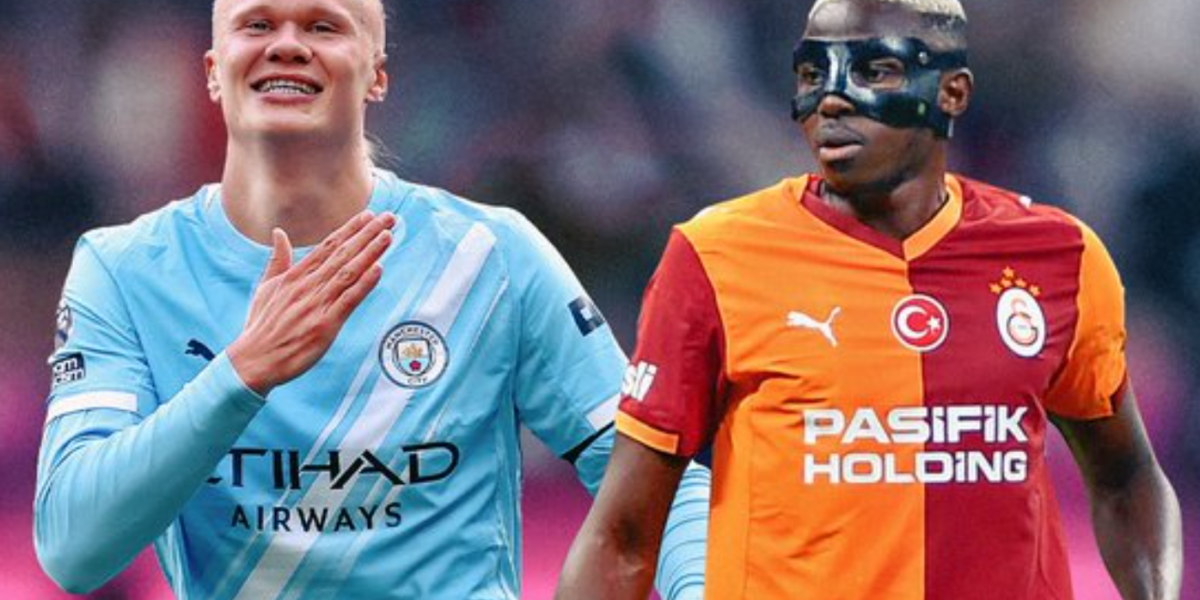
The debate between Erling Haaland and Victor Osimhen has become one of the most interesting striker comparisons in European football, with both forwards offering different qualities in the No. 9 position.
Haaland has built his reputation around extraordinary scoring numbers, while Osimhen combines goalscoring with pace, physicality and aggressive movement behind defensive lines. Their current situations also provide an interesting contrast as the 2026/27 season gets underway.
Haaland’s Record Speaks for Itself
Haaland remains one of the most prolific centre-forwards in the game. The Manchester City striker reached 100 Premier League goals in just 111 appearances during the 2025/26 campaign, breaking the competition record previously held by Alan Shearer.
His Champions League record is even more remarkable. UEFA reported in September that Haaland had scored 59 goals in 59 appearances in the competition, making him the fastest player to reach 50 Champions League goals.
The Norwegian has also started the current Premier League campaign strongly. He scored against Manchester United, Coventry City and Sunderland, while a brace against Crystal Palace helped him reach four goals after the opening four league matches. He then scored twice against Porto in the Champions League.
By September 20, Haaland had also scored in Manchester City’s 5-3 win over Sunderland, a result that maintained the club’s perfect league start.
Osimhen Brings a Different Threat
Osimhen’s game is not built around exactly the same qualities.
The Nigerian striker is particularly dangerous when there is space to attack. His acceleration, strength and ability to compete for crosses allow him to stretch defences in ways that can be difficult to measure simply through goals.
His record at Galatasaray demonstrates his consistency. During his first season at the club, Osimhen scored 37 goals in 41 appearances and helped the Turkish side win both the Süper Lig and Turkish Cup.
He followed that with 22 goals and eight assists in 33 official matches during the 2025/26 season, according to Galatasaray.
Osimhen has also made an impressive start to the 2026/27 league campaign. He scored six goals and supplied two assists across his first four Süper Lig appearances before injury interrupted his run.
Their European Records Add Another Layer
The Champions League provides another useful point of comparison.
Haaland has already established himself as one of the competition’s most prolific young scorers. UEFA’s records show that he holds the scoring record across his first 10, 20, 30, 40 and 50 Champions League appearances.
Osimhen has also developed an impressive European record. UEFA identified him in April 2026 as Nigeria’s leading Champions League goalscorer, with 16 goals at that stage.
During the 2025/26 Champions League campaign, Osimhen also ranked second for attempts on target with 25, while Haaland finished with eight goals in the competition.
So What Separates Haaland and Osimhen?
The comparison ultimately depends on what a team wants from its centre-forward.
Haaland is an exceptional penalty-box finisher whose positioning, physical strength and ability to convert limited opportunities make him particularly effective in a possession-based side that can consistently create chances around the box.
Osimhen offers a more dynamic threat when attacking space. His speed allows him to run beyond defenders, while his aerial ability and physical approach give his team another route into the final third.
There is also a current availability difference. Osimhen suffered a right adductor injury against Istanbul Başakşehir on September 4 and was still recovering later in the month, while Haaland has remained involved for Manchester City.
Both players therefore represent slightly different interpretations of the modern No. 9. Haaland’s extraordinary scoring record gives him a clear statistical profile, while Osimhen’s combination of pace, power, movement and finishing makes him a different type of attacking reference point.
Rather than being identical strikers competing for the same role, Haaland and Osimhen show how the traditional No. 9 position can be expressed in different ways at the highest level.